
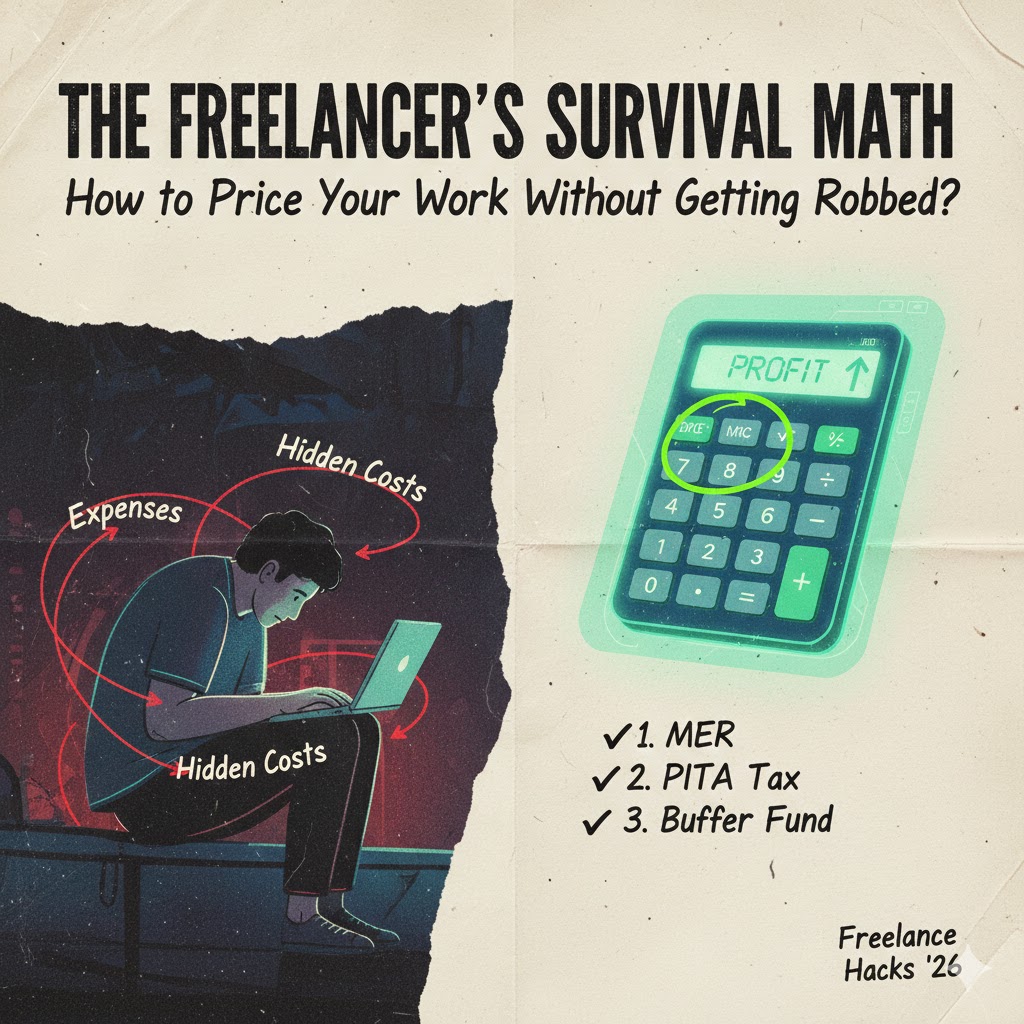
Believe me, I’ve been where you are. Back when I started my freelancing journey, I thought I was winning. A client offered me $150 for a project that I thought would take maybe a day. I was so excited that I didn’t even negotiate; I just hit “Accept.”
But then reality slapped me in the face.
That “one-day” project turned into a 10-day nightmare. Research took hours, the client asked for five rounds of “minor” revisions, and my laptop charger blew up halfway through. By the time I finished, I calculated my earnings and realized I was making less than $2 an hour. I wasn’t just broke; I was exhausted and felt like a failure.
I wasn’t a freelancer; I was a volunteer who was paying for the privilege to work.
By 2026, the freelance market has become a jungle. If you aren’t using math to protect yourself, you aren’t just losing money you’re being robbed of your time and your mental health. Today, I’m going to share the exact “Survival Math” I use on frecalculators.online to make sure I never get exploited again.
1. The Day I Realized “Market Rates” are a Lie

When I was struggling, I used to check what others were charging on Fiverr or Upwork and then quote $5 less just to get the job. Huge mistake. I eventually realized that “Market Rate” is a myth designed to keep us poor. Why should I charge the same as someone whose rent is $200 when my expenses are $1,500? I learned the hard way that your rate should be based on your bills, not someone else’s competition. If your math doesn’t cover your life, the project isn’t worth doing.
2. My Secret Weapon: The “Minimum Effective Rate” (MER)
This is the number that saved my career. Your MER is the absolute lowest amount you can charge to keep your lights on and your stomach full.
Here is how I personally calculate it (and you should too): I sit down and list everything: Rent, internet, food, that expensive coffee habit, and even the money I need to save for taxes (which is usually 30%). I take that total monthly cost and divide it by my actual billable hours.
I used to think I worked 40 hours a week. I was wrong. Between sending emails, chasing payments, and fixing bugs, I only really “work” for clients about 20 hours a week. When I did the math on our Home Page tools, I realized my hourly rate needed to be double what I was originally charging.
3. The Ghost Hours: The Unpaid Labor

In my old 9-to-5, I got paid even when I was just staring at the wall or chatting at the water cooler. In freelancing? Every minute you aren’t “producing” is unpaid.
I remember a week where I spent 15 hours on Zoom calls and 0 hours on the actual project. I was “busy,” but I earned $0. That’s when I started adding a “Project Management Fee” to every quote.
It’s like the concept I wrote about in my other guide, Ghost Mode: How to Delete Yourself from the Internet. Just like hidden data online can haunt you, “Hidden Hours” in your work can ruin your finances. Now, I track every second using calculators to make sure those ghost hours are paid for.
4. The “Pita” Tax: My Best Mental Health Move

This is something no textbook will teach you, but I swear by it. I call it the “Pain in the Ass” (PITA) Tax. We’ve all had that one client who sends “one more quick thing” messages at 3 AM. Early in my career, I just took it. Now? If I feel a client is going to be difficult, I automatically add 20-30% to the quote. If they pay it, the extra money makes the headache bearable. If they don’t, I’ve successfully avoided a nightmare. Your peace of mind has a dollar value don’t give it away for free.
5. Planning for the “Silent Weeks”

Last year, I had a month where not a single client knocked on my door. In the past, I would have panicked and taken a high-interest loan. But because I started using the savings and interest calculators on frecalculators.online, I had a “Dry Season Buffer.”
I now add a 10% “Safety Margin” to every single invoice. I don’t see this money as “profit”; I see it as insurance for the weeks when the world goes quiet.
6. Gear Depreciation: Your Laptop is Dying

One day, my laptop screen just went black. I had no money saved for a new one, and I missed three deadlines. That was my wake-up call.
Now, I treat my gear like an employee. Every hour I work, a small portion of my fee (I usually calculate it as $3/hour) goes into a “New Gear Fund.” It’s a small detail, but it’s the difference between a professional business and a hobby that can break at any moment.
7. Taxes: Don’t Let Them Surprise You
I thought I had $5,000, but the taxman reminded me I only owned $1,000 don’t make my mistake.
I’ll never forget my first tax season as a full-time freelancer. I thought I had $5,000 in the bank. Then I realized I owed the government $4,000. I almost cried.
Now, the moment a client pays me, I move 30% to a separate account. It’s not my money. It never was. If you find it hard to track these percentages, just use the simple math tools on our Home Page. It takes 10 seconds but saves you months of stress.
8. Why I Use Math to Say “No”
The greatest power I’ve gained is the power to say “No” to a bad deal. When someone offers me a “great opportunity” for low pay, I don’t get emotional anymore. I just open my calculator.
If the math doesn’t work, the answer is “No.”
Precision in your pricing shows the client that you aren’t just a “hired hand” you are a business owner. When you present a quote that is logically broken down, you command respect. In 2026, where AI is everywhere, your “Strategic Human Value” is what people pay for.
Final Thoughts: My Advice to You
If you’re tired of checking your bank account with fear every morning, stop guessing. Stop looking at what your competitors are doing and start looking at your own numbers.
I built frecalculators.online because I needed these tools myself. I wanted a place where I could quickly check my margins, plan my savings, and ensure I was actually making a profit.
Go to our Home Page and spend just 15 minutes today calculating your true costs. It changed my life, and I know it will change yours. And hey, if you want to keep your newfound freelance wealth safe from prying eyes, don’t forget to check out my guide on Digital Privacy.
You are worth more than you think. Now go do the math and prove it.