
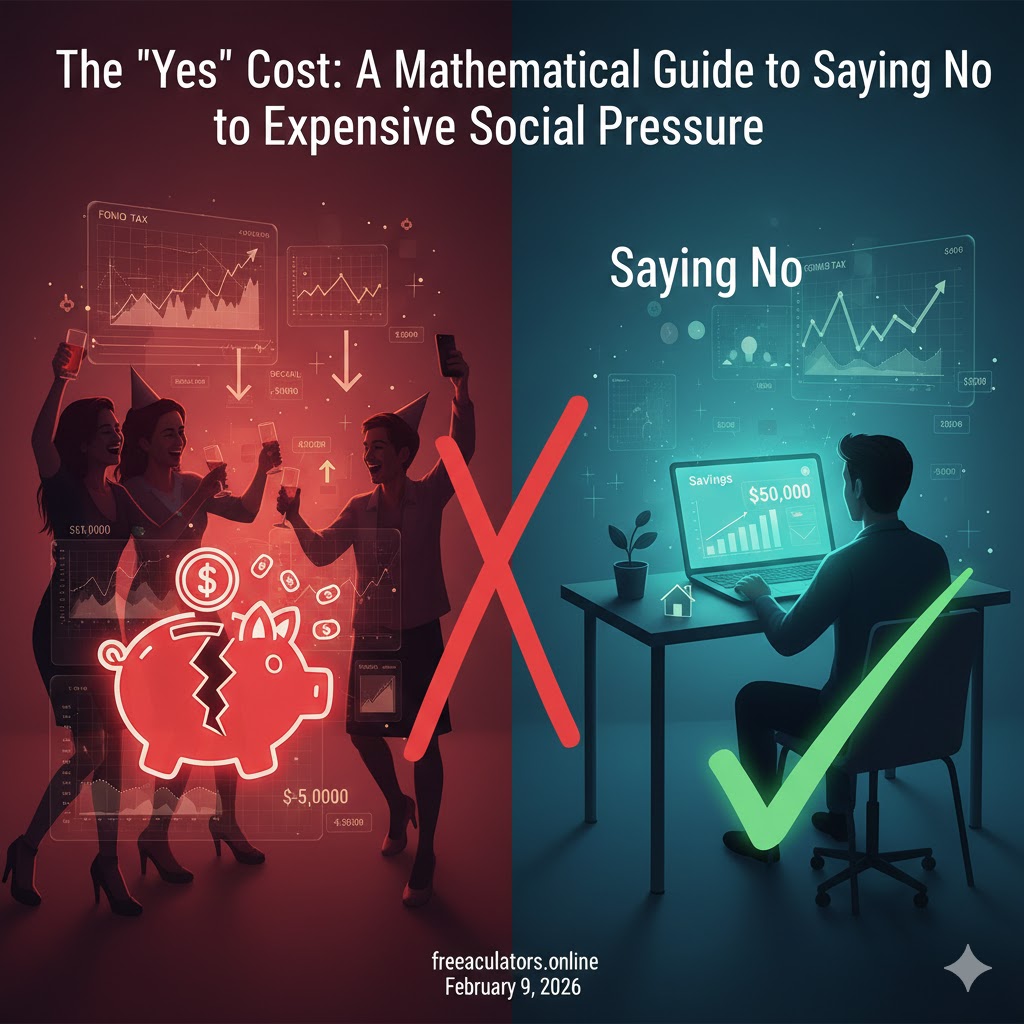
We all have that one friend who is always in the mood for a “party,” or that relative whose every milestone requires a new designer outfit and a lavish gift. Most of the time, we smile and say “Yes” without a second thought, ignoring the invisible dent this simple word makes in our bank accounts and mental peace. In 2026, where inflation is high and the pressure to perform for social media is at an all-time peak, learning to say “No” isn’t just a moral choice it’s a financial survival strategy.
Expenses driven by social pressure are essentially an “Invisible Tax” you pay, not for your own happiness, but for the attention and validation of others.
The Math of FOMO: Calculating the Social Opportunity Cost

“Social math: How your weekend ‘Yes’ subtracts years from your financial freedom.”
Let’s look at the numbers. Imagine you say “Yes” to just two plans a month that are outside your budget (a fancy dinner, a movie, or a weekend getaway). If one outing costs you $50, that’s $100 a month.
Over a year, that is $1,200. If you invested that same amount in a high-yield asset (assuming a 10% annual return), in 20 years, that money would grow to over $68,000.
| Social Event | Monthly Cost | 20-Year Opportunity Cost (at 10%) |
| Casual Outings | $100 | ~$68,000 |
| Destination Weddings | $500 (once a year) | ~$28,000 |
| “Status” Tech Upgrades | $1,000 (once a year) | ~$57,000 |
A Human Reflection: The Bitter Taste of a “Status” Meal

“Regret on a plate: When a social ‘Yes’ leads to a month of silent stress.”
I once knew a young professional who agreed to a dinner plan at a 5-star restaurant just to avoid looking “cheap” in front of his colleagues. The cost of that single meal was equivalent to his entire week’s grocery budget. Throughout the dinner, he wasn’t tasting the food; he was running a mental “calculator,” wondering how he would pay his electricity bill later that month.
When the bill arrived, he swiped his credit card with a forced smile. For the next three weeks, he lived on instant noodles and skipped social events he actually cared about. This is “The ‘Yes’ Cost.” We impress friends for two hours, but we face the anxiety alone for thirty days. Was the temporary “clout” worth the sleep deprivation? Absolutely not.
The “Subscription” of Social Status

“Status maintenance: Why trying to look rich is the fastest way to stay poor.”
Lifestyle inflation is a subscription with no “Cancel” button unless you are disciplined. When you say “Yes” to expensive trips just to keep up appearances (much like the pitfalls we discussed in our Travel on a Budget Guide), you aren’t just buying a vacation. You are setting a “standard” in the eyes of others that becomes increasingly expensive to maintain.
In 2026, “Smart Finance” isn’t about being a hermit; it’s about Selective Spending. If your heart isn’t in it, or your budget doesn’t allow it, saying “No” is the most valuable financial skill you can possess.
The 48-Hour Logic: How to Audit Your Social Invitations

“The Pause Button: A mathematical delay to prevent emotional spending.”
Next time you are pressured into an expensive commitment, don’t say “Yes” immediately. Use this 3-step audit:
- The Hourly Wage Test: Calculate how many hours you must work to pay for this event. If a single concert ticket requires 20 hours of stressful office work, is it a fair trade?
- The 48-Hour Buffer: Always ask for two days to “check your schedule.” Decisions made in the heat of the moment are usually emotional, not logical.
- Priority Check: Ask yourself, “Does this expense bring me closer to my big goals (buying a home, starting a business) or pull me further away?”
Building a “Fun Fund” to Say ‘Yes’ Without Guilt

“Planned Joy: Using dedicated budgeting to save your friendships and your savings.”
You don’t have to be a miser. The beauty of finance is in the balance. Just as we explored in The 90-Minute Focus Block, time and money both have a “Value per Second.”
- Create a “Social Fund” in your monthly budget.
- Once that fund is empty, every subsequent invitation is a “No” until the next month.
- This approach removes the guilt because you know exactly what you can afford to spend on joy.
Final Thoughts: Reclaiming Your Financial Sovereignty
“The ultimate freedom: Being okay with being the ‘boring’ friend while your wealth grows.”
Chasing social validation is a race with no finish line. People will eventually forget the expensive gift you gave them or the party you attended, but your bank account will always remember the loss. In 2026, the ultimate “flex” isn’t a flashy lifestyle; it’s Financial Independence.
The next time social pressure hits you, remember: Your ‘No’ to others is a massive ‘Yes’ to your future self.