
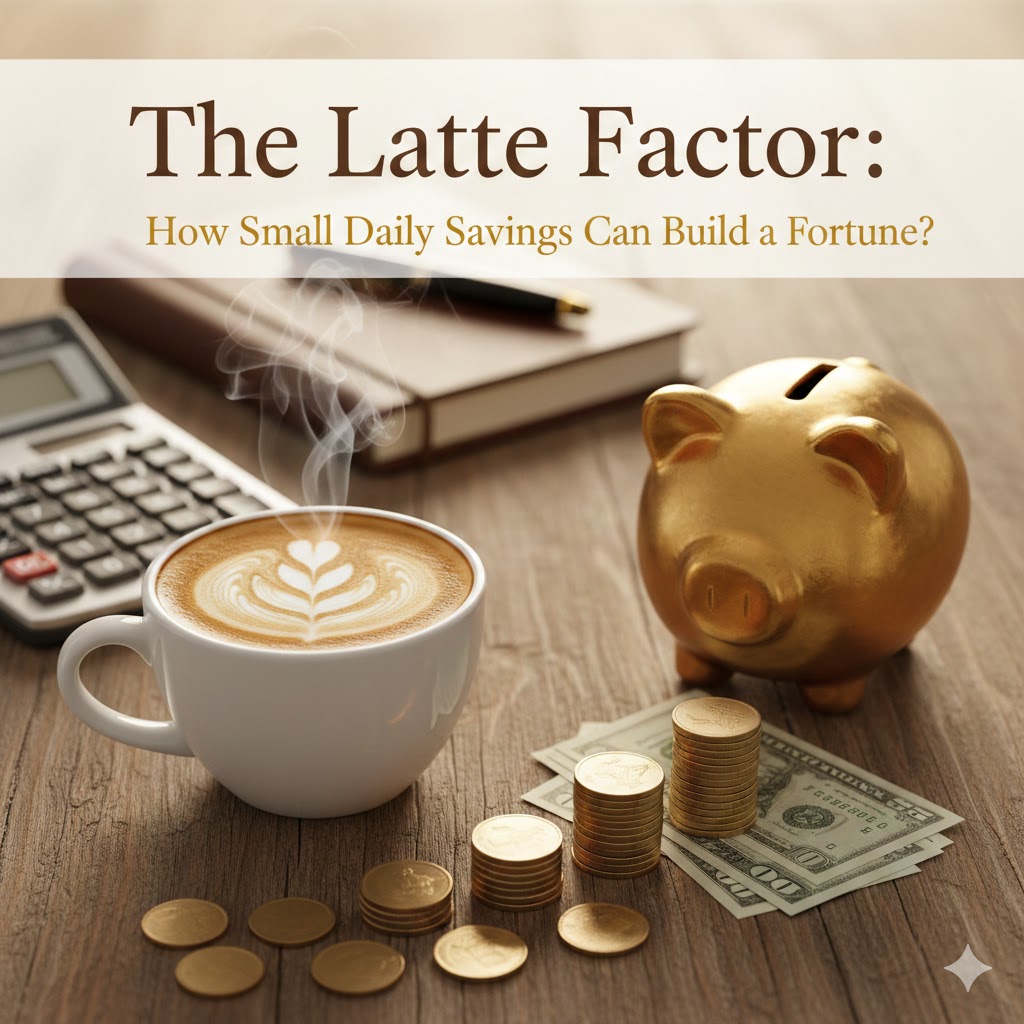
Most people believe that becoming wealthy requires winning the lottery, inheriting a fortune, or landing a high-paying executive job. However, in the world of personal finance, there is a powerful concept known as “The Latte Factor.” The premise is simple: the small amounts of money we spend daily on things we don’t strictly need like a cup of gourmet coffee, a snack, or an unused subscription—could grow into a massive fortune if saved and invested over time.
In this article, we will dive deep into how your small daily habits can transform your financial future and lead you toward true independence.
What Exactly is The Latte Factor?

The term “The Latte Factor” was coined by famous financial author David Bach. The goal isn’t to stop you from enjoying your coffee, but to help you realize that we all have enough money to start building wealth; we are simply “leaking” it through small, unconscious expenditures.
Think about it: If you save just $5 a day, you save $150 a month. While that might not seem like a life-changing sum today, the real magic happens when you factor in time and growth. To see the long-term impact of these small sums, you can visit frecalculators.online to use compound interest and savings tools that show how a few dollars today can turn into hundreds of thousands over twenty years.
The Power of Compound Interest: Your Best Friend

The secret sauce of financial independence is “Compounding.” Albert Einstein famously called it the “8th Wonder of the World.” When you invest your small savings, you don’t just earn interest on your initial money you earn interest on your interest.
- Time is Money: The earlier you start, the more time compounding has to work its magic.
- Consistency: Saving a small amount every single month is more effective than saving a large amount once in a blue moon.
- Rate of Return: With an average return of 8% to 10%, your money can double roughly every 7 to 8 years.
Common “Latte” Leaks in Our Daily Life

The “Latte Factor” isn’t just about coffee. It represents any recurring, unnecessary expense. Common leaks include:
- Streaming Services: Subscriptions for platforms you rarely watch or listen to.
- Dining Out: Frequent takeout or expensive lunches that could be easily prepped at home.
- Impulse Buying: Adding items to your cart during online sales just because they are “on offer.”
- Unused Memberships: Paying for gym or club memberships that you haven’t visited in months.
By tracking these leaks and optimizing your spending, you can find a significant amount of “hidden” money in your budget. To get a better handle on your monthly budget and financial planning, you can use the tools at frecalculators.online to organize your numbers efficiently.
Steps to Build Your Fortune
Building wealth is not an accident; it is a deliberate process. Follow these steps to harness the Latte Factor:
1. Track Your Expenses
For one full week, record every single penny you spend. You will be surprised to see where your money is actually going.
2. Pay Yourself First
As soon as you receive your paycheck, move your savings into a separate account immediately. Don’t wait to see what is “left over” at the end of the month.
3. Automate Your Savings
Set up an automatic transfer from your bank. This removes the temptation to spend and ensures your wealth grows consistently without you having to think about it.
4. Invest Wisely
Simply saving money isn’t enough because inflation eats away at your purchasing power. Invest in stocks, mutual funds, or other assets that grow faster than the rate of inflation.
The Psychological Shift

The Latte Factor is not about being cheap or living a life of deprivation. It is about “Mindful Spending.” Once you set your priorities, you realize that the security of a growing bank balance provides much more long-term happiness than a temporary caffeine fix or a random purchase. It’s about buying your future freedom.
Conclusion
Small steps lead to big destinations. Every dollar you save today is a seed planted for your future. Remember, wealth isn’t determined by how much you earn, but by how much you keep and how hard that money works for you.