
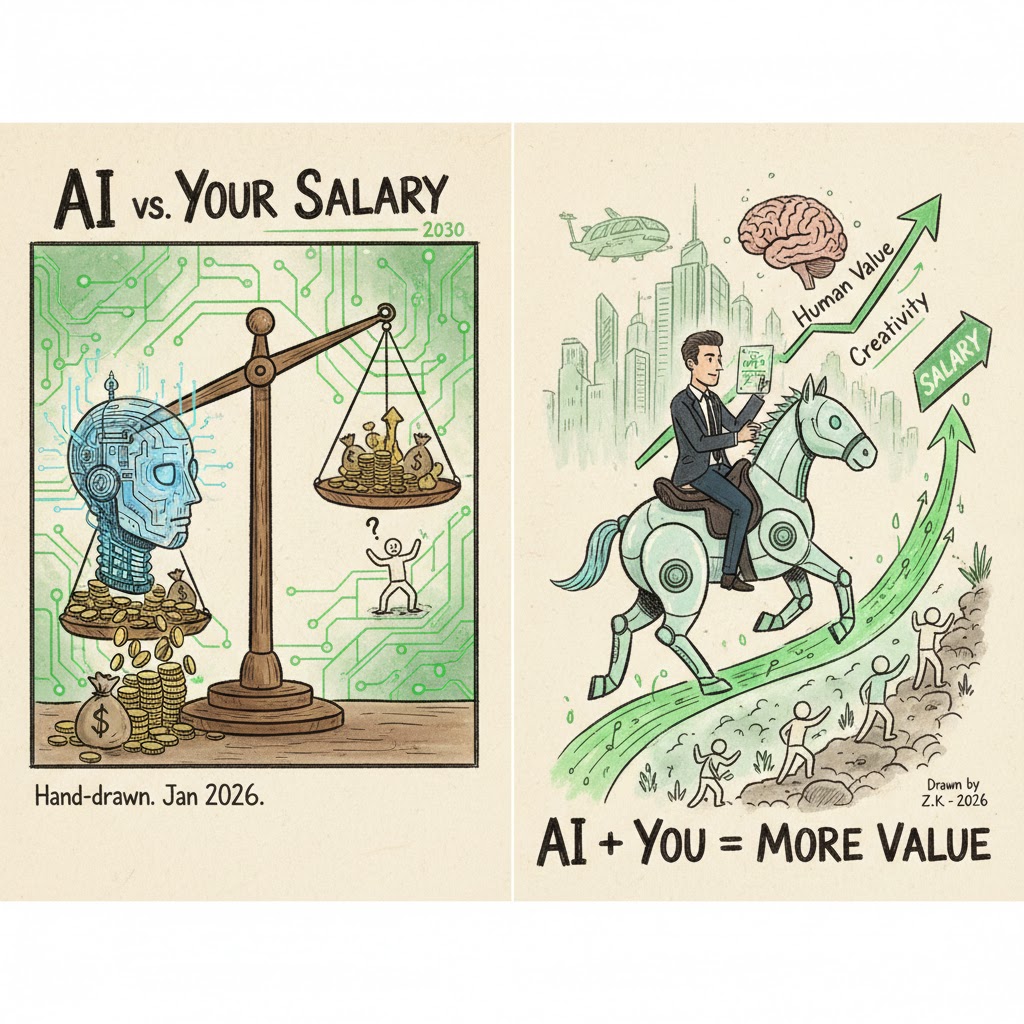
Let me tell you a story that hit me hard last year. I was sitting in a dimly lit cafe with a close friend of mine a guy who’s been a senior manager at a massive tech firm for nearly a decade. On paper, he’s “made it.” But he looked exhausted. I asked him, “Man, the pay is great, what’s with the face?” He took a long sip of his coffee and said, “The pay is great today, but I’m terrified of tomorrow. Tasks that used to take my team of ten an entire week are now being finished by an AI bot in two minutes. I honestly don’t know what my value will be by 2030.”
That conversation stayed with me. It’s a fear we all share, even if we don’t admit it over dinner. We are in a race where the opponent doesn’t sleep, doesn’t eat, and gets smarter every second. Will AI eat your salary, or will it be the rocket fuel that makes you wealthy? Let’s look at the cold, hard reality of 2030.
1. The “Displacement” Scare: Is Your Skill Becoming a Commodity?

Here is the bitter truth: by 2030, the market value of “routine work” will drop to near zero. If your job involves data entry, basic reporting, or any repetitive process, why would a company pay you a full-time salary? An AI tool can do it cheaper, faster, and without a lunch break.
But here’s the twist. As routine work becomes cheap, the value of Human Judgment skyrockets. Your future salary won’t depend on how much you work, but on how well you decide. As I discussed in my previous guide, Rent or Buy in 2026?, numbers are just tools. AI gives you the data, but the “wisdom” to use that data is your secret weapon.
2. The High-Wage Surge: The “Human + AI” Multiplier

Industry experts predict that by 2030, workers who “master the machine” will see their salaries surge by up to 30%. Think about it: if it used to take you 5 hours to write a proposal and now it takes 5 minutes with AI, your “Output per Hour” has exploded.
In 2030, the highest earners won’t be the ones with the most degrees; they’ll be the ones who can direct AI to solve complex business problems. To see how much your time is actually worth in this new economy, check out the productivity tools on our Home Page. You need to know your “hourly value” before the market decides it for you.
3. The Middle-Class Trap: Skill Polarization

The 2030 economy is going to be shaped like an hourglass. There will be high-skilled experts at the top and essential manual laborers at the bottom. The “Middle” the people who just process information, are at risk.
To stay relevant, you must make yourself “AI-proof.” Empathy, creative negotiation, and high-level strategy are things no algorithm can truly replicate. If you’re a freelancer, you absolutely need to read The Freelancer’s Survival Math to understand how to price your “humanity” in a world of bots.
4. Inflation vs. Your Paycheck: The Silent Salary Cut

While AI increases company profits, it doesn’t automatically increase your paycheck. By 2030, inflation will likely continue to erode your purchasing power. If your salary isn’t growing at 10-15% annually, you are technically getting poorer every year.
AI will help companies save money. Your goal is to make sure some of that saved money ends up in your pocket. You do that by becoming indispensable. Use the calculators at frecalculators.online to project your future living costs it’s a wake-up call you need to hear today.
5. The Final Verdict: More or Less?
The answer is simple but brutal: Your job will be worth MORE if you use AI, and significantly LESS if you try to compete with it.
The world isn’t ending; it’s just being rewritten. In 2030, the winners will be those who treated AI as a “Personal Intern” rather than a “Replacement.” AI is a tool, not a destiny. If you master the math and the machine, you won’t just survive you’ll thrive.