
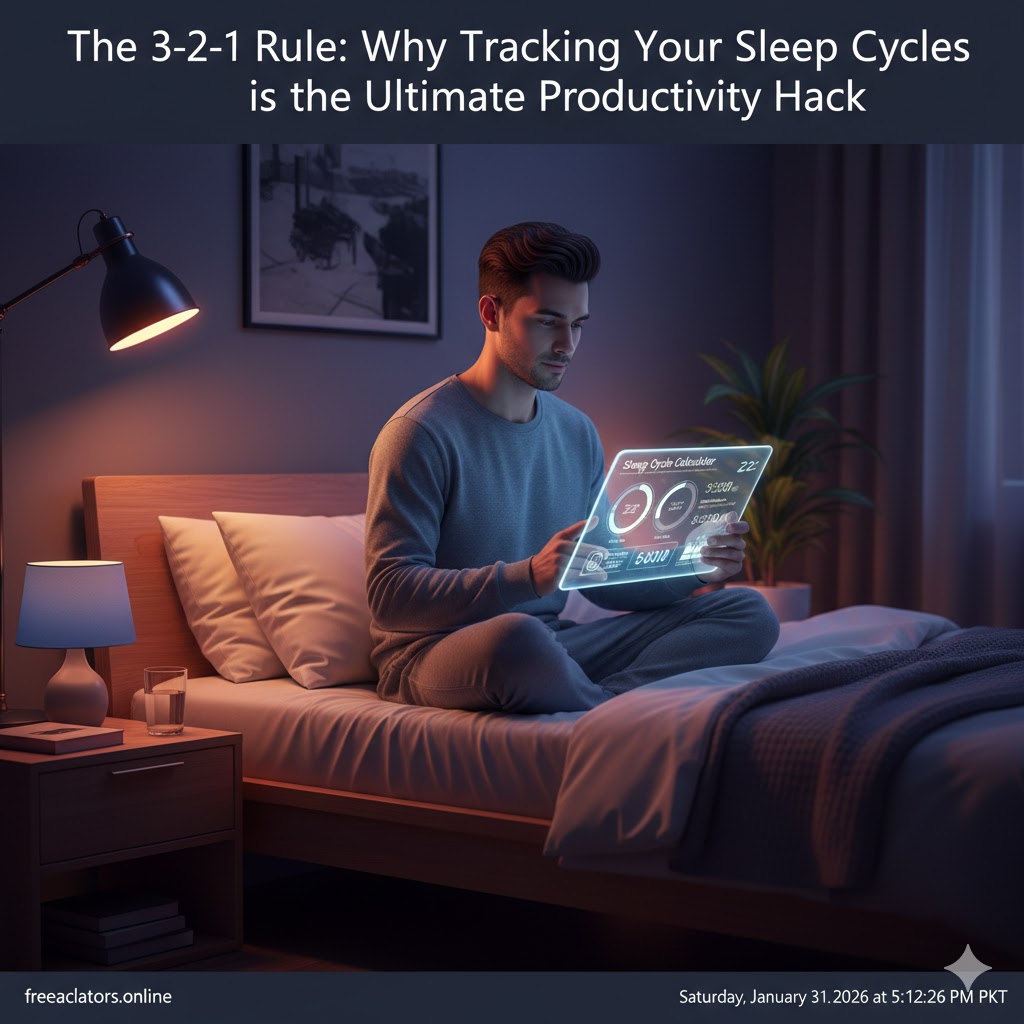
The Tiredness Loop
Do you wake up feeling exhausted even after a full 8 hours of sleep? For years, I lived in a constant state of “Brain Fog,” dragging myself through the day while relying on endless cups of coffee just to function. I used to think my diet was poor or that I was simply overworked, but the reality was much simpler yet more profound. I discovered that the issue wasn’t the quantity of my sleep, but rather the timing and quality of my rest. By failing to align my sleep with my body’s natural internal clock, I was essentially fighting against my own biology every single night.
My Personal Experience: The Midnight Scroll

I used to lie in bed for two hours every night scrolling through my phone, convincing myself that I was “winding down” from a stressful day. In reality, that blue light was sending “wake-up” signals to my brain, leaving me with heavy eyes and zero focus the next morning. It wasn’t until I stumbled upon the science of Sleep Cycles and the 3-2-1 Rule that I realized how much damage I was doing to my recovery. I decided to stop treating my rest as an afterthought and started managing it like a high-performance machine, and the results were nothing short of life-changing. I went from waking up grumpy to feeling genuinely refreshed before my alarm even went off.
1. What is the 3-2-1 Rule?

This rule is a simple yet powerful blueprint designed to prepare your body for deep, restorative sleep by eliminating common disruptors:
- 3 Hours before bed: Stop eating. This gives your digestive system enough time to process your last meal so your body can focus on cellular repair instead of digestion while you sleep.
- 2 Hours before bed: Stop working. Ending your professional tasks early allows your cortisol levels to drop, preventing that “tired but wired” feeling that keeps your mind racing at midnight.
- 1 Hour before bed: Screens off. Eliminating blue light from phones and laptops allows your brain to naturally produce Melatonin, the hormone responsible for helping you fall asleep effortlessly.
2. The Math of Sleep Cycles

Our sleep isn’t a flat line; it moves in 90-minute “cycles” that take us through light, deep, and REM sleep. If you wake up in the middle of a deep sleep cycle, you will experience “sleep inertia,” leaving you groggy for hours regardless of how long you slept. Understanding the math behind these cycles is the key to waking up feeling energized. It allows you to strategically time your wake-up call so that it coincides with the lightest part of your sleep journey. By mastering this timing, you can actually feel better on six hours of synchronized sleep than on nine hours of interrupted sleep.
3. Use Technology to Your Advantage

Trying to manually calculate 90-minute intervals while you’re already tired is a recipe for frustration and error. I realized that if I wanted to be consistent, I needed a reliable way to map out my night without doing mental math in the dark. This is why I now rely on frecalculators.online to handle the technical side of my routine. Their lifestyle and health calculators allow you to input your desired wake-up time and instantly receive a list of the best times to fall asleep. It takes the guesswork out of the equation, ensuring that every minute you spend in bed is optimized for maximum recovery.
4. Why Blue Light is Your Enemy
Blue light mimics the sun, tricking your brain into thinking it’s still the middle of the afternoon even when it’s past 11 PM. This digital interference suppresses Melatonin production, which is why you can feel wide awake even after an exhausting day at the office. When you use the tools at frecalculators.online to track your habits, you begin to see the direct correlation between late-night screen time and poor morning performance. Seeing the data in front of you makes it much easier to put the phone down and prioritize your long-term health over a temporary dopamine hit.
5. Consistency Leads to Energy

Within just three days of following this mathematical approach to sleep, my energy levels didn’t just improve they doubled. I found myself finishing tasks in half the time because my brain was no longer struggling to process basic information through a haze of fatigue. When you stop fighting your natural rhythm and start working with it, productivity becomes a natural byproduct rather than a forced effort. You stop living for the weekend and start enjoying the clarity that comes with a truly rested mind and body.
Conclusion
Great sleep isn’t a matter of luck; it’s a matter of calculation and discipline. If you are tired of feeling like a zombie every morning, it is time to stop guessing and start measuring your rest. Head over to frecalculators.online today, optimize your sleep schedule using their precise tools, and commit to the 3-2-1 rule for one week. Your brain will thank you with sharper focus, and your body will reward you with more energy than you’ve felt in years.